Aeolus Station
The largest and most famous of Mesulea’s atmospheric mining ports, stationed near the edge of Magna Fons (colloquially “The Fountain”)—the largest surface storm on Mesulea.
Concept Art
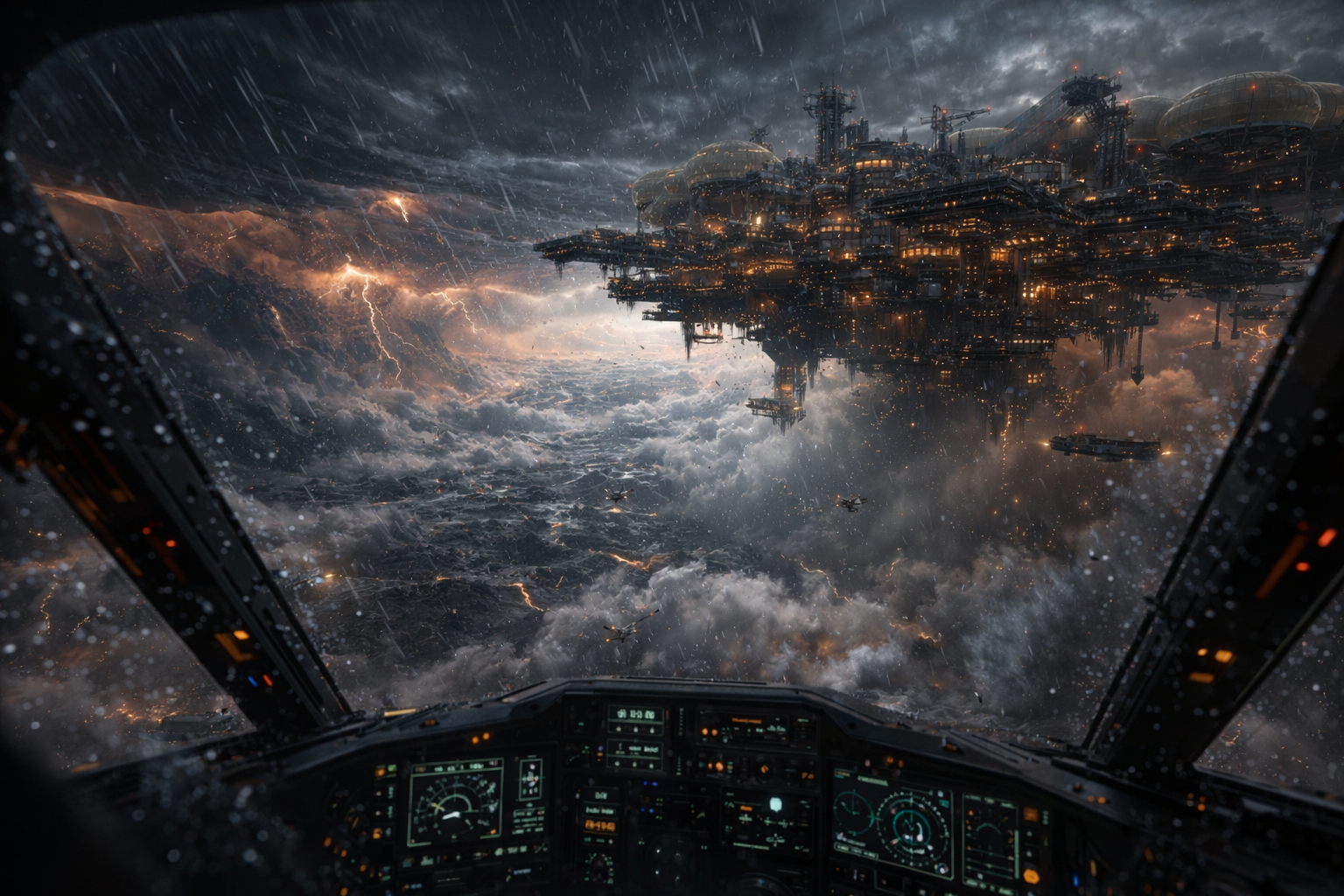
The Fountain
Helium-3 density increases by several orders of magnitude in the storms in Mesulea’s upper atmosphere. A rich layer of liquid helium-3 exists several hundreds of kilometers below the 1 bar boundary (the “surface”). The vortices at the center of storms sometimes penetrate to this layer and pull large amounts of helium-3 up to the thermosphere.
Aeolus Station, along with numerous other stations, rests on the edge of The Fountain. Caught in the angular winds of the storm’s edge, the station orbits the storm epicenter.
Physical Form
Hundreds of permanent mining stations exist on Mesulea, the largest being Aeolus Station.
Buoyancy & Propulsion
- Stations are kept aloft by hydrogen balloons
- Maneuver in the atmosphere with chemical thrusters
- Built to flex—assumed to be struck by turbulence events that would destroy conventional orbital habitats
Facilities
Stations serve as ports for:
- Worker shuttles
- Gas mining aircraft
- Helium-3 container ships
They also operate:
- Intermediary helium-3 warehouses
- Helium-3 refineries
Helium-3 Mining Process
Collection
Helium-3 is mined from storms by aircraft:
- Aircraft fly through the storm searching for gas patches with high helium-3 concentration
- They pull in the gas
- Gas is taken back to the station
Processing
- Gas is deposited into tanks in the station’s warehouse
- Goes through a filtration process
Transport
When the station is fully laden:
- A helium-3 container ship takes the fuel to the Helium-3 Orbital Complex
- Launches must be scheduled precisely to:
- Make rendezvous with the Complex in orbit
- Minimize the number of launches
- Minimize the time warehouses are full
- From the Complex, helium-3 is taken to market
Population
113,483 inhabitants
Workforce
The majority are workers and administrators who work on the station in shifts of 1 month on, 2 weeks off.
Services
The rest tend to work for or own businesses in the market district, providing amenities to the workers.
Life on Aeolus
Social Hierarchy
- Pilots: Celebrities and liabilities
- Techs: Keep the station alive; resent everyone
- Admin/Security: Act like a state within a state
- Service workers: Food, sanitation, medical—underpaid and indispensable
Environment
Aeolus is loud, vibrating, cramped, and chemically clean in all the wrong places:
- Air smells like polymer, disinfectant, and hot metal
- Every corridor has emergency signage for pressure loss, toxic exposure, and “storm surge conditions”
Shift Culture
Brutal: sleep is scheduled around storm windows, not human needs.
Hazards (Routine)
These are not exceptional events—they are normal operating conditions:
- Turbulence spikes: Sudden events that throw unsecured bodies into bulkheads
- Pressure cycling: Micro-leaks become chronic maintenance battles
- Electrical events: Lightning and induced currents force intermittent blackout protocols
- Radiation/particle storms: Require comms/sensor “quiet” periods
Rumors
Aeolus is a natural cover for anything requiring isolation and plausible deniability (“storm damage” explains many anomalies).
Persistent rumor classes (unconfirmed):
- Anomalous helium signatures that behave “too well” compared to expected isotopic performance
- Whispers of restricted sampling runs below standard safety depth
- A quiet program that treats The Fountain as more than just an industrial resource